

How to Tell a Rook from a Carrion Crow: A Field Guide for Beginners
Rooks and carrion crows look alike at a glance, but bill shape, bare skin, plumage sheen, social habits and calls separate them cleanly. Here is how to tell them apart in the field.
You are walking a field edge in late autumn and two black birds lift off the stubble. One is chunkier, one has a pale, bony-looking face, and both are heading for the same line of trees. Crows and rooks are the pair that trip up most British birdwatchers at the start, and the honest truth is that a distant silhouette in bad light can defeat anyone. Get closer, or get a better angle, and the differences are straightforward enough to spot in seconds. This guide covers what to look at, in the order that usually works best.
Start with the face, not the body
If you only remember one thing, make it the bill and the skin around it. Look at an adult rook head-on and you will see a greyish-white, slightly pimply patch of bare skin at the base of the bill, where the feathers stop short. It is often called the "face patch" or "bare face" and it is the single most reliable rook feature. On a carrion crow, that area is fully feathered, so the bill appears to grow straight out of a black head.
The bill shape differs too. A rook's bill is longer and more pointed, with a steep forehead rising sharply into the crown, giving the head a peaked, almost triangular profile. It looks built for probing. A carrion crow's bill is shorter and heavier, with a gentler curve and a more rounded head shape. Once you have seen a few of each, the crow looks blunt and the rook looks sharp.
Two cautions. The bare face is much less obvious on juveniles, which can look confusingly crow-like for a few months in summer and autumn. And on a bird facing directly away or silhouetted against a bright sky, you may not see the face patch at all. Do not force an identification from one angle.
Size and build: real, but subtle
Rooks are roughly the size of a carrion crow, and the overlap between a small female rook and a large male crow is real. Size alone is a poor identifier. What helps is posture and proportion.
- Rook: longer, more slender wings; a somewhat loose, "baggy" look about the rear; a distinctly peaked crown; a tail that can look slightly longer in proportion.
- Carrion crow: stockier, more compact, with a broader chest, a flatter crown and a rounded, almost bull-necked outline. Often described as looking like it has been put together more solidly.
Watch a crow walk across a lawn and you see a heavy, deliberate bird. Rooks tend to look more angular and lighter on their feet, especially when they are striding about a field in a group.
Which bird is with which?
Behaviour is often the quickest route to an answer, especially when the light is poor.
Rooks are sociable nearly all year
Rooks nest in colonies, sometimes dozens of untidy stick nests in the tops of a few tall trees, and they feed in loose flocks on grassland and arable fields. Even outside the breeding season you will usually see them in company, often spread out across a field like a scattered line of grazing birds. They also gather at traditional winter roosts, sometimes in large numbers.
Wherever rooks are, there is noise: a constant, conversational racket of caws from birds in a tree or a field. If you hear a whole tree arguing with itself, you are almost certainly listening to rooks.
Carrion crows are usually alone or in pairs
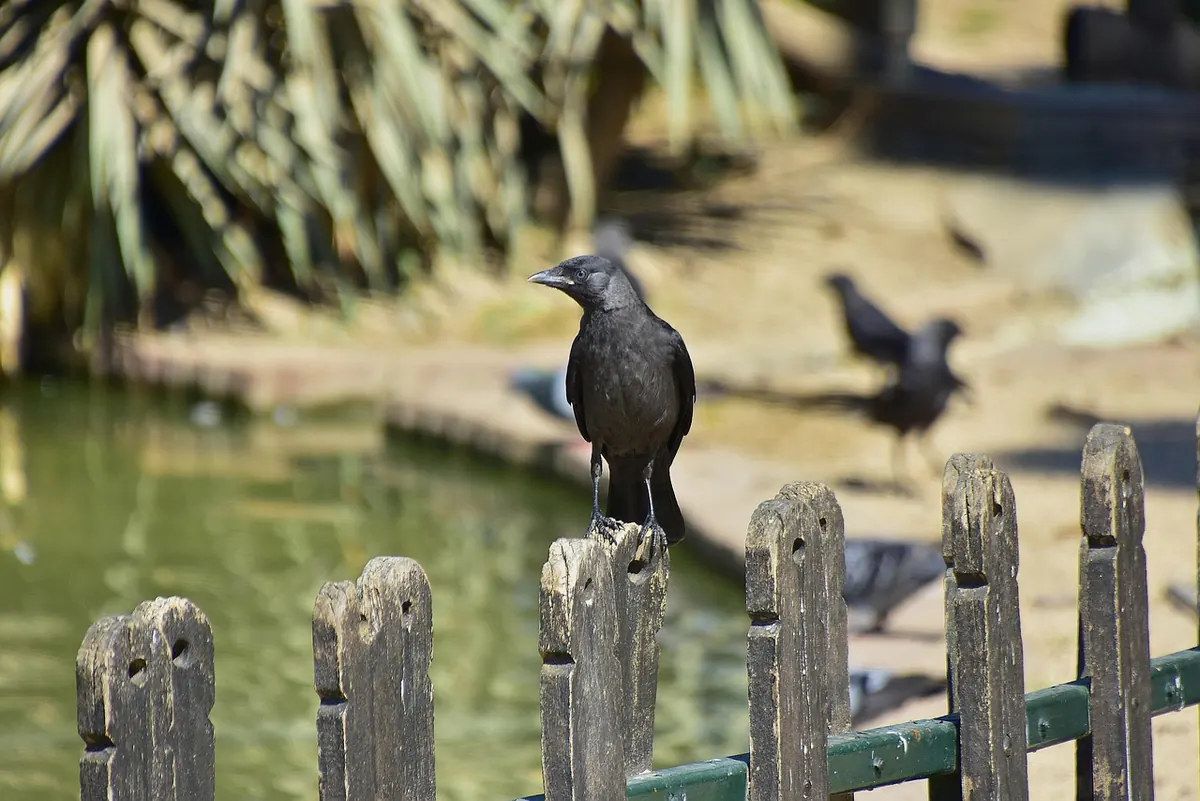
Carrion crows hold territories and are generally seen singly, in pairs, or as a family party of three or four. A single crow on a fence post, on a roadside verge or patrolling a garden lawn is exactly what you would expect. They will tolerate each other at a good food source, but they do not form flocks in the way rooks do.
Jackdaws complicate things, because they flock and nest in cavities, often in the same trees as rooks. Jackdaws are smaller, with grey necks and pale eyes, so they are usually easy to rule out, but a mixed rookery will have both.
Plumage: black, but not the same black
Both species are black, and at a distance that is all you will see. In decent light, the texture is different.
A carrion crow's plumage is a flat, solid black, with a slight green or purple gloss visible on the wings and back when the sun catches it. A rook can look glossier and more "oily", with blue or purple iridescence over the head and body in good light, and the feathers on the flanks and thighs often appear shaggy or slightly loose, as though the bird needs a moult. That said, the iridescence varies with angle, age and light, so treat it as a supporting clue rather than a deciding one. Never identify a bird purely on the colour of its sheen.
Calls: the clincher
Voice is where the two birds part company most decisively, and it travels further than plumage detail.
- Rook: a relaxed, drawn-out, slightly nasal kaah, often repeated and given in chorus by many birds at once. Think of the sound of a rookery at dawn — a rolling, ragged conversation rather than a sharp statement.
- Carrion crow: a hard, flat, clipped caw, usually given singly or in twos and threes, and much more forceful. It sounds like the bird means it.
Learning that difference is worth an hour of your time. Listen to recordings, then listen again in the field, and you will find you can identify a bird you cannot even see properly.
A quick field routine
- Listen first. A chorus suggests rooks; a single harsh caw suggests a crow.
- Look at the social context. Flock feeding in a field or a tree full of stick nests means rooks.
- Get a head-on or side-on view of the face. Bare greyish skin at the bill base means rook. Feathered means crow.
- Check the profile. Peaked crown and long pointed bill versus rounded head and heavy bill.
- Use sheen and build only as supporting evidence.
Practising and getting it wrong
Pick one reliable feature and carry it with you until it becomes automatic. For most people it is the bare face patch, backed up by voice. Then spend time watching known birds — a rookery you pass on the way to work, or a pair of crows on a local playing field — so your eye has a reference for what "normal" looks like.
Expect to get it wrong now and then. That oddly plain-faced bird in August may well be a juvenile rook. That distant shape on a grey afternoon may stay unresolved, and leaving it unidentified is better than logging a guess. Birdwatching rewards patience more than certainty, and a bird you watch for five minutes while it feeds will teach you more than a dozen hurried glances. Keep a notebook if you like, note what the bird was doing as well as what it looked like, and come back to the same places through the year. Rooks in particular change character when the colony is active in spring, and seeing that for yourself locks the identification in for good.
Photo: Gerhard_Romero / Pixabay